2026/4/3 14:25:45
Bus Cable for Industrial Communication
A practical selection guide for RS-485, CAN Bus, PROFIBUS and industrial data networks
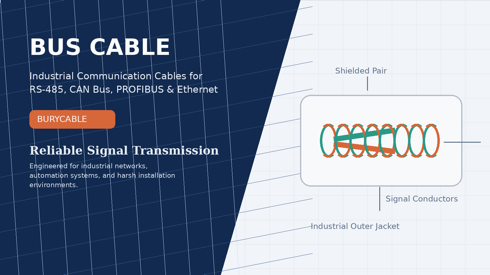
Bus cable is the communication backbone of modern automation systems. The right cable design improves signal integrity, reduces downtime, and supports stable operation in electrically demanding environments. |
What Is Bus Cable?
Bus cable is a communication cable used to connect multiple devices on the same control or data network. Unlike standard power cable, it is engineered for predictable electrical performance, low interference, and stable signal transmission.
In industrial environments, bus cable is commonly specified for RS-485, CAN Bus, PROFIBUS, and other fieldbus or industrial data systems. Most designs rely on twisted-pair construction to support differential signaling and reduce noise pickup. Depending on the protocol, impedance, capacitance, shielding structure, and conductor geometry become critical to communication quality.
Why Bus Cable Matters in Industrial Networks
Communication performance depends not only on the controller or device, but also on the cable connecting the entire network. A poor cable choice can introduce reflections, attenuation, intermittent faults, or complete communication loss.
· Stable data transmission over long distances
· Better resistance to electromagnetic interference
· Lower signal attenuation and fewer reflected signals
· Improved uptime in factories, transport systems, and process plants
· Easier system integration and lower commissioning risk
Main Types of Bus Cable
Bus cable is not one single product. It is a family of communication cables designed around specific protocols and installation environments.
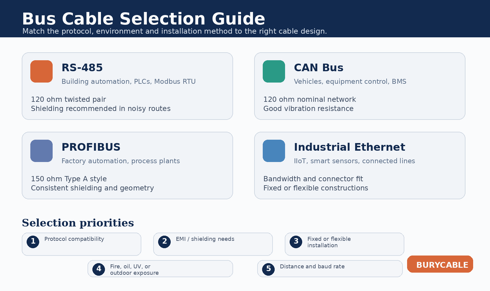
Type | Typical Applications | Nominal Impedance | Design Focus |
RS-485 | PLCs, Modbus RTU, BMS, instrumentation | 120 ohm | Twisted pair, shield when routed near power |
CAN Bus | Vehicle systems, BMS, equipment control | 120 ohm | Stable geometry and good vibration resistance |
PROFIBUS | Factory automation, process plants | 150 ohm | Consistent shielding and industrial jacket |
Industrial Ethernet | IIoT, smart sensors, connected lines | Varies by design | Bandwidth, connector fit, fixed or flexible use |
Typical Construction of Bus Cable
Although designs vary by protocol, many bus cables share a common technical logic: signal conductors, balanced pair geometry, shielding, and an outer sheath selected for the real installation environment.
Key Selection Factors
· Protocol compatibility: impedance, capacitance, and conductor geometry should match the communication standard.
· EMI conditions: shielded constructions are preferred in routes close to drives, motors, switchgear, or power cables.
· Installation method: fixed tray installation, conduit, outdoor routing, drag chain, and robotic motion require different constructions.
· Environmental resistance: consider oil, UV, moisture, chemical exposure, and temperature range.
· Distance and baud rate: longer runs demand tighter control of attenuation and signal reflection.
· Fire performance: projects may require flame-retardant, low-smoke, halogen-free, or fire-resistant properties.
Quick Selection Guide
Application | Recommended Cable | What to Check First |
PLC and Modbus network | RS-485 bus cable | 120 ohm pair, shield when EMI is present |
Vehicle or mobile equipment | CAN Bus cable | Vibration stability, temperature range |
Factory automation line | PROFIBUS cable | 150 ohm construction, shielding quality |
IIoT sensor connection | Industrial Ethernet cable | Bandwidth, connectors, route flexibility |
Building automation loop | RS-485 or fieldbus cable | Fire performance, routing conditions |
Where Bus Cables Are Used
Bus cables are widely used in industrial automation, oil and gas, water treatment, building management systems, transportation, renewable energy, smart infrastructure, and machine control. As systems become more connected, the cable itself becomes a more critical part of total network reliability.
Common Problems Caused by Wrong Cable Selection
· Intermittent communication faults during commissioning or operation
· Signal reflections caused by impedance mismatch
· Reduced transmission distance or unstable baud-rate performance
· Noise-related data errors in high-interference environments
· Unexpected downtime caused by jacket or shielding failure
Why BURYCABLE
At BURYCABLE, we position bus cable as an engineered solution rather than a commodity item. Our communication cable offering can be tailored for shielding level, jacket compound, fire performance, UV resistance, oil resistance, flexibility, and project-specific installation demands.
For OEM buyers, contractors, distributors, and industrial project teams, the right result comes from matching the cable design to the actual protocol and field conditions - not just the product name on the quote.
Project CTA Need help specifying the right bus cable for your project? Send BURYCABLE your protocol, voltage level, routing conditions, shielding requirement, installation method, and target market. Our team can recommend a more suitable cable construction and quotation basis. |
FAQ
What is the difference between bus cable and ordinary control cable?
Bus cable is designed around communication performance, including pair geometry, impedance consistency, and shielding effectiveness. Ordinary control cable may not provide the same signal stability for data networks.
Should bus cable always be shielded?
Not always. In low-noise routes, unshielded constructions can work. In most industrial installations, however, shielding improves reliability and is often the safer specification.
Can one bus cable be used for every protocol?
No. Different protocols have different electrical requirements. A cable suitable for RS-485 may not be the best choice for PROFIBUS or industrial Ethernet.
What information should a buyer provide before asking for a quotation?
Protocol type, conductor size preference, fixed or flexible use, installation environment, flame requirement, shielding requirement, and estimated project quantity are the most useful starting points.